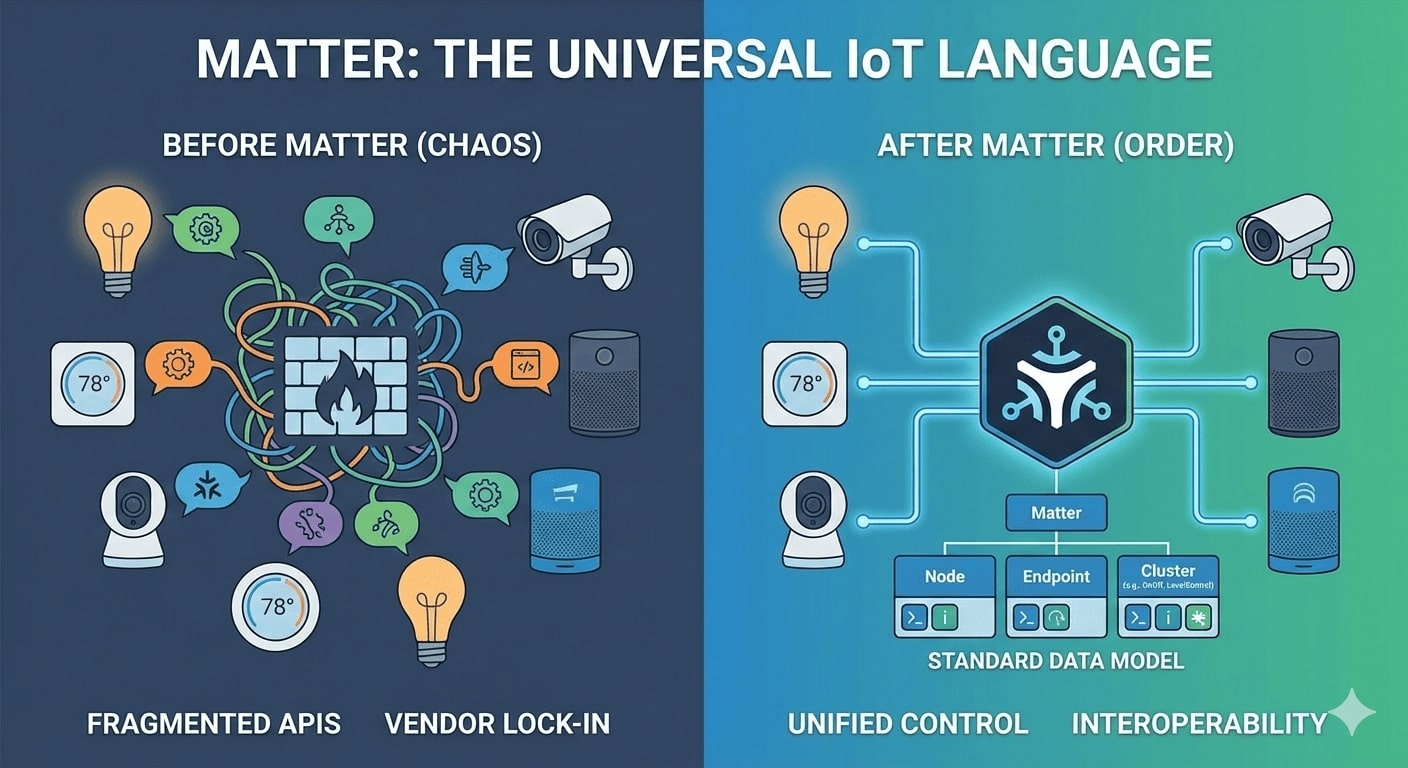
The Industrialization of Interoperability
Let’s strip away the consumer marketing. Forget about asking Siri to change your living room colors. For the IAIOT (Industrial AIoT) architect, the Matter standard represents a fundamental shift in how we build edge infrastructure.
For decades, we have been trapped in the “Driver Hell.” Integrating a new sensor into a SCADA or BMS (Building Management System) meant writing a custom parser, mapping registers manually, and hoping the vendor didn’t change the firmware payload.
Matter (formerly Project CHIP) is not just a protocol; it is an Application Layer Unification that sits on top of IP. It is the industry’s first serious attempt to treat physical devices with the same architectural rigor as microservices.
Here is why experienced system integrators and AI engineers need to pay attention.
1. The Death of Cloud Dependency: Local First, Always
The most critical—and often overlooked—feature of Matter for professional deployment is mandatory local control.
Unlike the previous generation of IoT devices that were glorified API hooks to an AWS Lambda function, a Matter device must be fully controllable over the local LAN (Wi-Fi/Ethernet) or Thread mesh.
- Latency: Sub-100ms response times become the standard, not the exception.
- Resilience: If the internet fiber is cut, the factory/office automation must continue to function. Matter enforces this at the protocol level.
- Security: Matter utilizes blockchain-style Device Attestation Certificates (DAC). Every device is cryptographically verified upon commissioning. No more default passwords; no more spoofed MAC addresses.
For the IAIOT architect, this means we can finally build Air-Gapped intelligent systems that are interoperable without being vulnerable.
2. The Data Model: A Semantic Schema for the Physical World
You know standard HTTP GET/POST. Matter introduces something more valuable: Standardized Semantics.
In legacy systems (Modbus, proprietary MQTT), a value of 255 at register 4001 could mean “75 degrees Fahrenheit” or “Emergency Stop.” You needed an external map to decode it.
Matter enforces a rigid, self-describing Data Model:
- Nodes & Endpoints: A clear hierarchy of device capabilities.
- Clusters (Interfaces): A
Thermostatcluster is identical whether it’s from Honeywell, Siemens, or a generic ESP32. It must exposeLocalTemperature,OccupiedCoolingSetpoint, and support specific commands.
This is Object-Oriented Programming applied to Hardware.
As a developer, you stop writing code for vendors and start writing code for capabilities. You code against the LevelControl interface, and it works instantly across 500 different device SKUs.
3. The Bridge to the Brownfield
We don’t work in greenfield vacuums. The world is full of Modbus, DALI, KNX, and Zigbee. Matter anticipates this through the Bridge Device Type.
A Matter Bridge acts as a translation layer. It exposes non-Matter devices (like a legacy PLC or a bank of Zigbee sensors) as virtual Matter Endpoints to the rest of the network.
The Strategic Opportunity: Instead of ripping and replacing infrastructure, SIs can deploy Matter Bridges to “wrap” legacy operational technology (OT). This exposes ancient machinery as modern, IP-addressable, standardized objects that your modern IT/AI stack can interact with seamlessly.
4. The Missing Link for GenAI Agents: Zero-Shot Control
This is where the “AI” in IAIOT comes into play.
Current LLMs (Large Language Models) struggle with IoT because IoT data is unstructured and proprietary. You have to fine-tune a model to understand that {"v": 1, "t": "x86"} means “turn light on.”
Matter provides the Context that AI lacks.
Because Matter devices self-advertise their capabilities using a standard schema, an LLM Agent can:
- Scan the network and ingest the device structure (e.g., “I see a Node with
ColorControlandOnOffclusters”). - Map User Intent (“Make it focused working mode”) to specific Cluster attributes (Color Temp: 6000K, Level: 100%) without hallucinating proprietary API calls.
- Execute Deterministically using standard Matter interaction models.
Matter is the standard language that allows AI to talk to machines. Without it, your AI is just a chatbot. With it, your AI becomes an Operator.
Conclusion: Your Infrastructure Strategy
Matter is still maturing. The multi-admin features can be complex, and Thread border routers are still finding their footing in enterprise environments.
However, the trajectory is clear. The era of “Walled Gardens” is ending, replaced by Software-Defined IoT.
Your Move:
- Stop building proprietary APIs for your new hardware.
- Investigate Matter Bridges to modernize your current Modbus/Legacy deployments.
- Prepare your Data Pipeline to ingest Matter’s structured events rather than raw telemetry.
The revolution isn’t about a smarter lightbulb. It’s about a standardized, programmable physical reality.