The Wild West of Robotics — 3 Cracks in the Foundation We Can’t Ignore
If you spent any time around the robotics community this year, you’ve probably felt it too: excitement, chaos, genius… and a mild sense of impending disaster.
Jim Fan from NVIDIA said it best in his end-of-year reflection:
“Everyone’s freaking out about vibe coding. In the holiday spirit, allow me to share my anxiety on the wild west of robotics. 3 lessons I learned in 2025.” — Jim Fan, Director of Robotics & Embodied AI, NVIDIA
His thread was refreshingly honest. No polished marketing. No “watch our robot do a backflip” highlight reel. Just a researcher saying out loud what most of us whisper in labs, factories, and Discord channels.
Let’s unpack those cracks.
1. The Body Got Smart Faster Than the Brain
Humanoids finally look like… well, humanoids. Actuators are stronger, limbs are smoother, hands are more articulate. The craftsmanship is genuinely impressive.
But intelligence? Control? Planning? That’s where the magic fizzles out.
Fan described the imbalance bluntly: the robots’ bodies can do more than their AI brains currently know how to command. In his words, “the body is more capable than the brain.”
And then comes the real gut-punch: hardware reliability is the silent progress killer.
Unlike simulated agents or LLM training runs, real robots overheat, burn motors, crash firmware, and break gearboxes. Every failure stalls software iteration. You can’t “just rerun the experiment” when the robot is in pieces and your ops team is staring at you with a repair checklist.
Industry analyses echo this challenge too — hardware faults directly slow AI iteration and demand heavy operational support.
Trend to watch: Hardware is no longer the bottleneck. Stable hardware is. And until that stability improves, AI progress will always feel like running on a treadmill made of glass.
2. Benchmarks Are a Mess, and We All Know It
LLMs have MMLU. Software agents have SWE-Bench. Robotics has… vibes.
There is no unified evaluation standard — not for hardware, not for tasks, not for scoring, not for simulation settings.
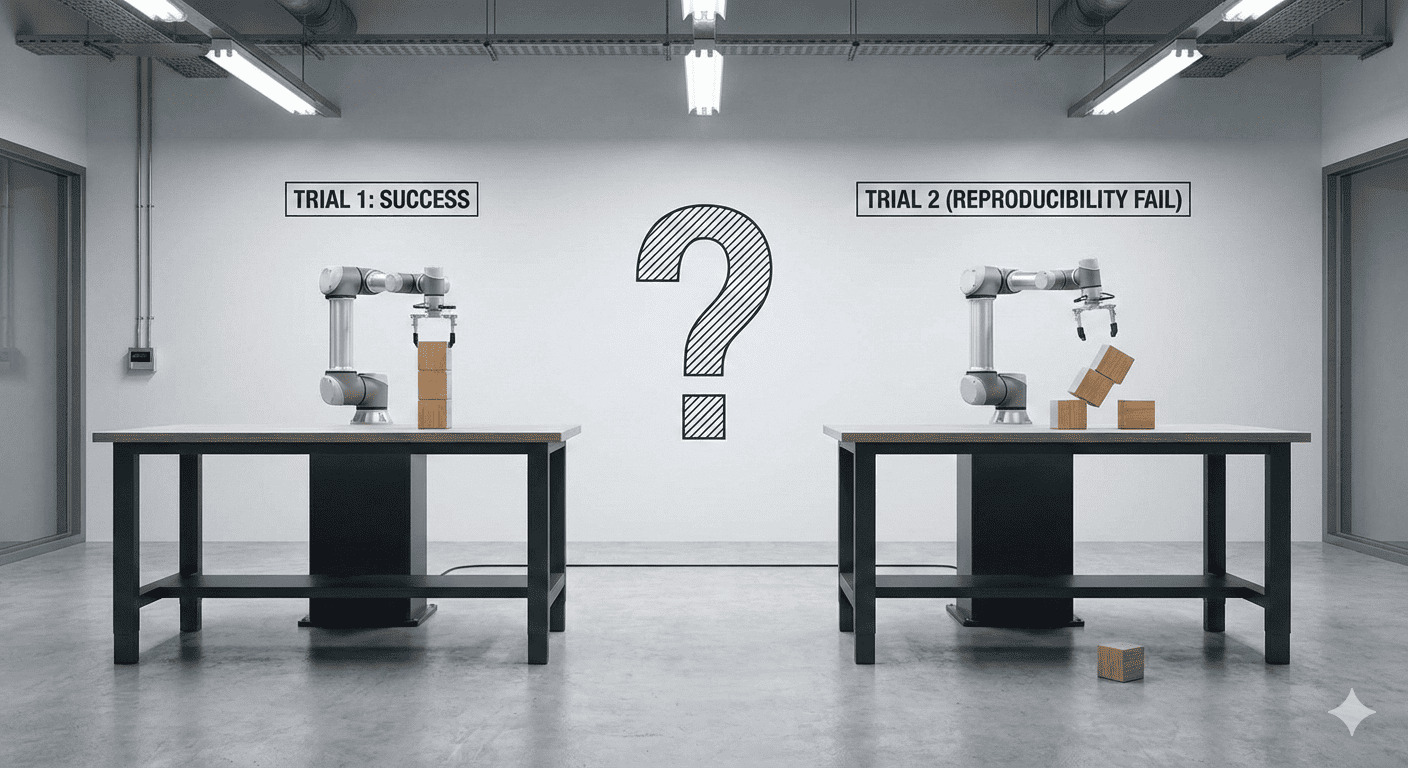
So what happens? Every company publishes their own rules, films 200 trials, selects the 3 that look cinematic, and announces a breakthrough. It’s not malicious — it’s structural chaos.
A historical benchmark review pointed out the same systemic issue long before 2025: reproducibility and standardization have always been fragmented in robotics.
Trend to watch: 2026 will be the year we stop treating benchmarking like an afterthought. The community is already pushing large-scale reproducible benchmarks for language-conditioned robot manipulation — early signs of convergence.
Reality check: Progress isn’t real until it can be reproduced by someone who isn’t paid to make it look good.
3. VLA Models Aren’t the Savior We Hoped For
Right now, Vision-Language-Action (VLA) models are the mainstream “robot brain” recipe. Take a pre-trained vision-language model (VLM), bolt on an action module, fine-tune, pray.
It works for demos. It struggles in physics.
Fan raised two sharp critiques:
- Most VLM parameters are devoted to language and knowledge, not physical or spatial reasoning.
- Visual encoders are trained to drop low-level details — great for VQA leaderboards, terrible for dexterous control.
So scaling VLMs doesn’t automatically scale robotic intelligence. Because the pre-training objective itself is misaligned.
Meanwhile, the academic community has also observed that current VLA models show limited generalization in long-horizon physical planning, reinforcing the same skepticism.
Alternative trend rising: Jim Fan and NVIDIA are betting on video-based world models as a better pre-training target for embodied policies — models that learn space, time, and dynamics first, and language second.
Trend to watch: We’re shifting from “does the robot understand the prompt?” to “does the robot understand the world?”
So… What Can We Actually Do About It?
Here’s the good news: you don’t need to work at NVIDIA to matter.
1. Build and support open benchmarks
If you’re in research, contribute tasks, metrics, evaluation harnesses. If you’re in industry, advocate for shared standards instead of private scoreboards.
2. Improve sim-to-real transfer
Better physics, better domain randomization, better reality approximations. Simulation isn’t the enemy — unrealistic simulation is.
3. Share real robot data
Not just the wins. The failures. The edge cases. The boring attempts that didn’t make the demo reel. That’s where the real research gold lives.
4. Focus on physical intelligence, not linguistic intelligence
Ask different questions. Train on different signals. Reward models for interacting with the world, not describing it.
5. Join the community efforts
Robotics isn’t a spectator sport. It’s a messy, multidisciplinary relay race. The baton is always being dropped. Pick it up when you can.
Final take
Robotics is no longer waiting for its “GPT moment.” It’s waiting for its ImageNet moment, its SWE-Bench moment, its scaling law for physics moment, and most importantly: its reliability moment.
2025 proved one thing clearly: robots are becoming real, but real robots are exposing unreal assumptions. The future belongs not to the flashiest demo, but to the most reproducible science and the most grounded training objectives.
And the rest of us? We contribute by caring enough to build what’s missing.
Because progress isn’t just about the smartest robots. It’s about the smartest ecosystem around them.
References
-
Jim Fan (@DrJimFan) — Everyone’s freaking out about vibe coding. In the holiday spirit… X (Twitter), December 28, 2025. https://twitter.com/DrJimFan/status/2005340845055340558
-
Moomoo Tech News — NVIDIA’s Jim Fan: The robotics field is still in the wild west. https://www.moomoo.com/news/post/63369884/nvidia-s-jim-fan-the-robotics-field-is-still-in?utm_source=chatgpt.com
-
VLABench: A Large-Scale Benchmark for Language-Conditioned Robotics Manipulation with Long-Horizon Tasks — ICCV 2025 paper. https://openaccess.thecvf.com/content/ICCV2025/papers/Zhang_VLABench_A_Large-Scale_Benchmark_for_Language-Conditioned_Robotics_Manipulation_with_Long-Horizon_ICCV_2025_paper.pdf