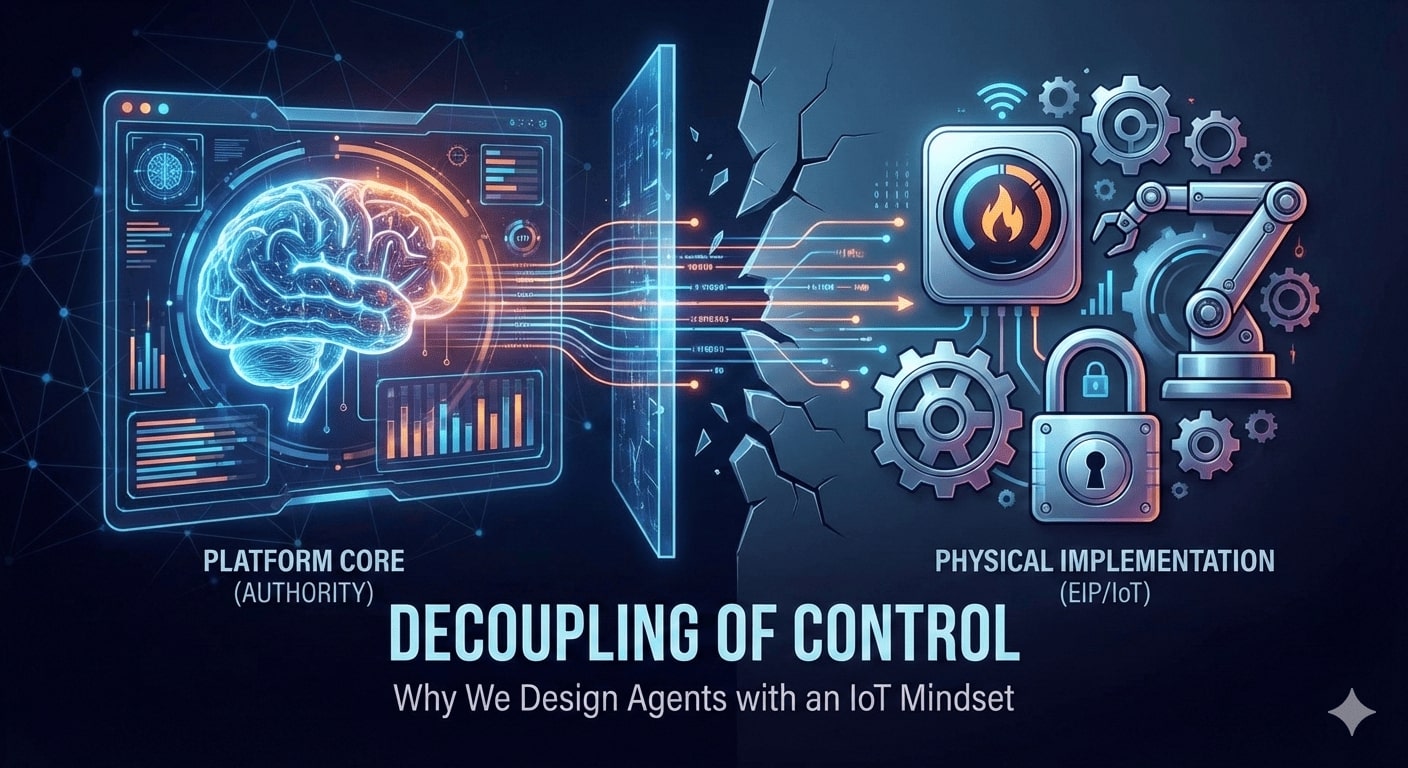
While everyone is scrambling to make LLMs “chat” better, we are actively restricting them. This is precisely why we are ready to rule the physical world.
1. The Elephant in the Room: AI is a Giant with Only a Mouth
Walk into any coffee shop in Silicon Valley right now, and you’ll hear the buzz: Context Windows, RAG pipelines, or the latest Transformer architecture. This is normal; we are in the middle of a gold rush.
But if you look closely, you’ll notice an awkward truth: 99% of AI applications are still trapped inside a “chatbox.”
We treat AI like a super-intern. We ask it to write emails, generate images, or debug code. But the moment we ask, “Can you turn on the heater in the living room?” or “Can you sign for my package?”
It replies: “As an AI language model, I cannot interact with the physical world.”
This isn’t because AI isn’t smart enough. It’s because we are designing software architecture incorrectly. We are designing AI Agents the same way we design Web Servers: Request → Response → End.
This architecture is perfect for the web, but for the physical world (Embedded AI), it is a disaster.
That is why we made a seemingly crazy decision: Before we bought a single piece of hardware, we forced our pure software platform to comply with strict IoT (Internet of Things) standards.
2. How We Killed the “God SDK”
In most AI Agent platforms, the SDK is God. Developers write llm.call(), db.save(), or even api.post() directly inside the SDK. The SDK does everything.
But in our technical constitution, “Agent Definition Compiler & Runtime Forbidden Zone” (Internal Protocol), we did something that drives developers crazy:
“The SDK is strictly prohibited from containing any Runtime Code. It is merely a Compiler.”
This means you cannot write “how to execute” inside the SDK. You can only write “this is a Contract.”
Why do we do this?
Because in the physical world, “Authority” and “Implementation” must be physically isolated. Imagine if your smart heater app contained the actual “heating logic.” If the app crashes or the phone loses signal, the heater could spiral out of control and catch fire.
So, we sliced the architecture into three distinct parts:
- Platform Core (The Authority): The only entity allowed to give orders.
- SDK (The Architect): Draws the blueprints but is forbidden from touching the bricks.
- EIP (Execution Implementation Provider): The worker that actually does the dirty work (whether it’s GPT-4 or your home heater).
3. When “Software Agents” Meet the “Matter Standard”
When we dove deep into Matter (the connectivity standard for smart home devices), we were shocked to find that the software architecture we designed based on our “Execution Lifecycle & Authority” protocols aligned perfectly with Matter’s Data Model.
In the world of Matter, you don’t call turnOnLight().
You simply set a state: TargetState: { OnOff: True }.
Then, the device asynchronously reports back: ReportedState: { OnOff: True }.
This is exactly how our Platform Core operates.
We treat every AI Agent—whether it’s writing a report, analyzing financial statements, or controlling a robotic arm—as an “Asynchronous State Machine.”
- Traditional Architecture: User → API → Function Call → Result (Synchronous waiting, blocking).
- Our Architecture: User → Core (Sets Desired State) → Digital Twin (EIP) → Physical Implementation.
By introducing this “Digital Twin” mechanism, we solved the two hardest problems in Embedded AI:
- Security: Since the SDK cannot touch the Runtime, hackers cannot inject malicious commands via the Agent Definition.
- Stability: Even if the hardware (EIP) goes offline, the Core still holds the “Desired State,” waiting for the hardware to reconnect and sync automatically.
4. Why Is This Worth a 100x Return?
Now, let’s look at the power this architecture unlocks.
While our competitors are rewriting their entire backend to figure out “how to make a Python script control Bluetooth,” we only need to do one thing:
Add a new EIP Adapter.
Because from Day 1, our Platform Core API has no idea who it is talking to. It only knows how to send a Command and receive a Report.
- Yesterday, this EIP was an OpenAI API Wrapper.
- Today, this EIP is a Docker container.
- Tomorrow, this EIP can be a raw ESP32 Chip.
We don’t need to change a single line of code in the Platform Core. We don’t need to update any UI in the Official Client. For the user, clicking “Start Task” feels exactly the same, whether it triggers a GPU in the cloud or a heating coil under the floor.
This is the revelation the Matter Standard gave us: True Artificial General Intelligence (AGI) isn’t about how well it generates text, but how elegantly it integrates into heterogeneous physical systems.
5. A Note to Developers
If you are building AI products, stop and look at your code. If your Business Logic and Execution Logic are tangled together, you are building an unscalable island.
Reference our core philosophy:
- Keep Authority in the Core.
- Push Implementation to the Edge.
- Communicate via State, not Action.
This path is difficult at first. You will write a lot of “seemingly redundant” interface definitions. But the moment your AI successfully controls the physical world for the first time, you will realize that this was all preparation for a future where AI is Ubiquitous.
And in that future, we already have the ticket.
[Technical Appendix: Reference Standards]
The following documents are proprietary internal protocols and are not available for public review:
- Platform Constitution & System Boundary — Defines the absolute decision-making power of the Core.
- Execution Lifecycle & Authority — Establishes the asynchronous state machine operation mode.
- Official Client Contract — Ensures complete decoupling of the UI layer from the Implementation layer.
Interested in how we transform Agents into Matter-ready architectures? We do not publish our full technical specs, but we are open to strategic discussions.
👉 Contact Us to learn more about our platform architecture.